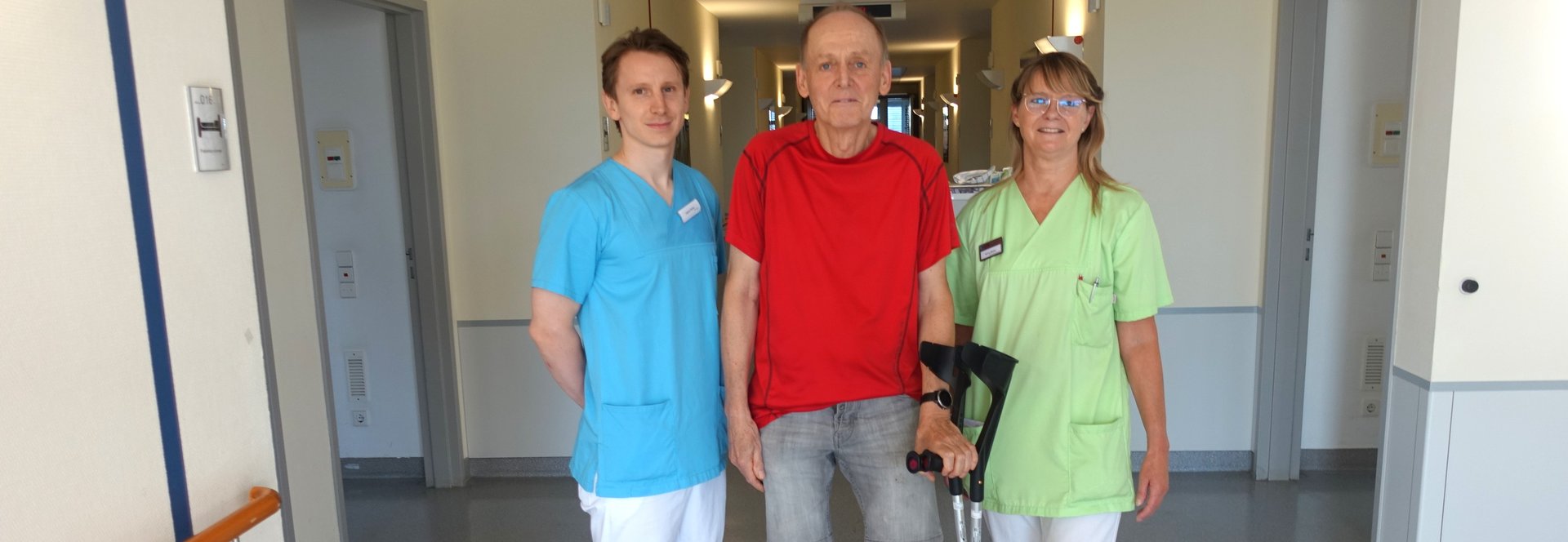
For Siegbert Held from Mainz, Tuesday began like any other day. The 65-year-old retiree was riding his bike in Ginsheim to go shopping. Around 10:30 a.m., however, he suffered a serious fall: Held landed awkwardly on his hip and sustained a femoral neck fracture.
Just about 45 minutes later, at 11:15 a.m., he was admitted to the emergency room at GPR Klinikum. As a patient in the Department of Trauma, Hand, and Reconstructive Surgery, headed by Robert Gerstung, he received immediate trauma surgery care and diagnostic evaluation there. After the X-ray examination, it quickly became clear that surgical treatment was necessary. Due to the nature of the fracture, it was necessary to replace the injured hip joint with an artificial hip.
“Mr. Held’s X-ray showed a femoral neck fracture, in which case preserving his natural hip joint would not have been the optimal treatment. Therefore, after the examination, it was clear to us that we would recommend the implantation of an artificial hip,” explains Robert Gerstung.
From the Accident Straight to Surgery
Further treatment was carried out in close collaboration with the Orthopedic Clinic at GPR Klinikum. As early as 2:20 p.m.—not even four hours after the accident—Siegbert Held underwent surgery performed by Senior Physician Dr. Ingmar Bothe. Bothe is a specialist in orthopedics and trauma surgery as well as a certified lead surgeon for knee and hip arthroplasty.
The collaboration between the two clinics is particularly important in cases of hip joint injuries: The Trauma Surgery Department handles immediate care following the accident and the trauma assessment. If a joint replacement becomes necessary due to the injury, the specialized expertise of the Orthopedic Clinic can be immediately brought in.
“In the case of a femoral neck fracture, it is crucial to make the right treatment decision quickly and then implement it consistently. The close collaboration between trauma surgery and orthopedics allows us to immediately combine the expertise of both fields and treat the patient without unnecessary delays,” says Dr. Ingmar Bothe.
Mobilized
Just Three Hours After Surgery Things moved particularly quickly after the procedure. Just about three hours after the surgery—which lasted only 35 minutes—Held was mobilized for the first time. He was allowed to put weight on the operated leg right away.
“To be honest, I was surprised that I was allowed to get back on my feet just a few hours after the surgery,” reports Held. “At first, I thought that after an injury like that, I’d have to stay in bed for a long time. Instead, I was mobilized right away.”
Such early mobilization is made possible by the Fast-Track concept established at GPR Klinikum. “The goal here is to get patients back on their feet as quickly as possible after joint replacement surgery and help them regain their independence,” says Dr. Manfred Krieger, chief of the Orthopedic Clinic.
A New Hip and Back Home
Already By 11 a.m. on Thursday, the time had come: Just about 48 hours after his bicycle accident, Siegbert Held was able to leave the GPR Clinic—with a new hip.
“For me, it all happened incredibly fast,” says Held. “On Tuesday morning, I was still riding my bike to go shopping, and by Thursday morning, I was already able to go home. Of course, I would have preferred to avoid the accident, but when something like this happens, you couldn’t ask for better—and above all, faster—care at the GPR Klinikum.”
This case impressively demonstrates how important close interdisciplinary collaboration is for complex injuries. From rapid diagnosis in the trauma surgery department, through the joint decision to proceed with joint replacement, to the specialized joint replacement surgery and subsequent early mobilization, the individual treatment steps are seamlessly integrated.
In Siegbert Held’s case, this collaboration made it possible—within just a few hours—to progress from the emergency room through diagnosis and surgery to early mobilization, allowing the 65-year-old to return to his familiar surroundings just two days later. And Held already has a clear goal in mind for the time after his hospital stay: he wants to get back on his bike as soon as possible. After all, he hopes his next trip to Ginsheim will go off without a single stop at the hospital.