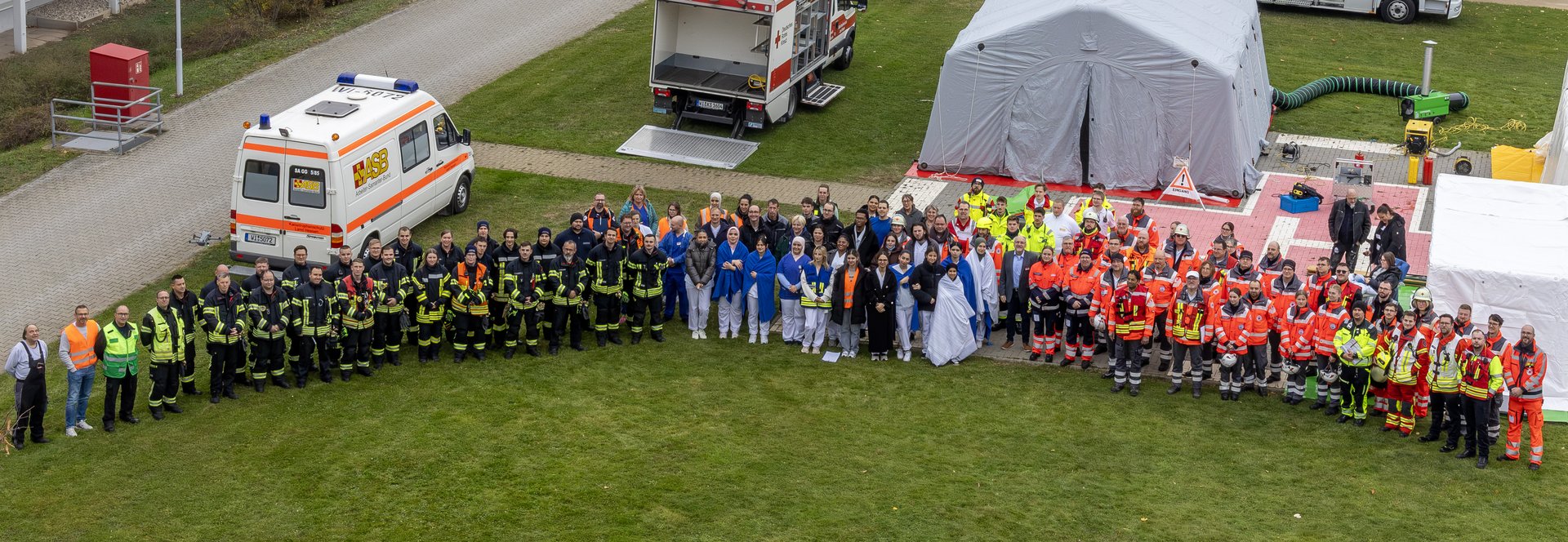
How does coordination work when numerous injured people suddenly need to be treated at the same time? And how do emergency responders react when additional hazards arise during such a situation? These questions were the focus of a large-scale exercise on mass casualty incidents (MANV) that took place on November 7, 2026, at the GPR Clinic. The exercise was organized by the GPR Vocational School for Nursing in collaboration with the fire department, the German Red Cross (DRK), and units from ASB, Veritas, and the Malteser.
The goal of the exercise was to train personnel in handling a complex emergency situation under conditions as realistic as possible and to test the cooperation among the participating emergency responders and staff. Particular emphasis was placed on structured patient care, coordination among those involved, and taking the correct actions when sudden additional hazards arise.
The exercise scenario began in the emergency room (ER). Ten patients were simulated by actors, and several family members also participated in the exercise. After receiving a handoff from a registered nurse, five trainees took over the care of the simulated patients. One trainee bore special responsibility, taking charge of the team and coordinating the care procedures.
Later in the exercise, a resuscitation situation was simulated. During this procedure, a fire broke out in the nursing staff room, necessitating the evacuation of the emergency department. The patient actors were first transferred to the endoscopy recovery room and then taken through the radiology department to a specially set-up outdoor treatment area. The chosen transfer route made it possible to conduct the drill while minimizing disruptions to regular hospital operations as much as possible.
The exercise provided all participants with the opportunity to test procedures under realistic conditions and to practice coordination among different professional groups and organizations. Especially in the event of a mass casualty incident, it is crucial that medical staff, emergency medical services, the fire department, and disaster response units work hand in hand and maintain a clear overview even under extreme time pressure.
“The training for registered nurses is very comprehensive and is designed to prepare our trainees for as many situations as possible. The fact that we can teach topics such as crisis management and emergency care in such a realistic manner is not a given and is only possible thanks to the exceptional dedication of our staff, as well as our close collaboration with emergency medical services, disaster response teams, and the fire department,” emphasized Stefan Keller, deputy managing director of the GPR Health and Care Center.
The successful execution of the drill underscores the importance of hands-on training and cross-organizational collaboration. After all, especially in extraordinary emergency situations, clear procedures, good communication, and mutual trust among those involved are crucial to ensuring the best possible care for patients.